Terraced streets are some of Britain's hardest homes to decarbonise. Many are in areas of fuel poverty and have limited external space for Air Source Heat Pumps. Increasingly electric boilers are being fitted as they’re cheap for landlords to put in and meet EPC C requirements. But they are expensive to run and have high peak loads on the network, triggering expensive reinforcement. There is currently no community centric, scalable pathway to affordable decarbonisation for mixed tenure terraced streets.
SP Electricity North West has received over £7 million in funding for our Net Zero Terrace Beta Project, which will showcase a novel solution to decarbonising six million terraced homes, enabling communities to replicate the approach, ensuring no-one is left behind in the net zero transition. This project is funded through the Strategic Innovation Fund, an Ofgem programme managed in partnership with Innovate UK.
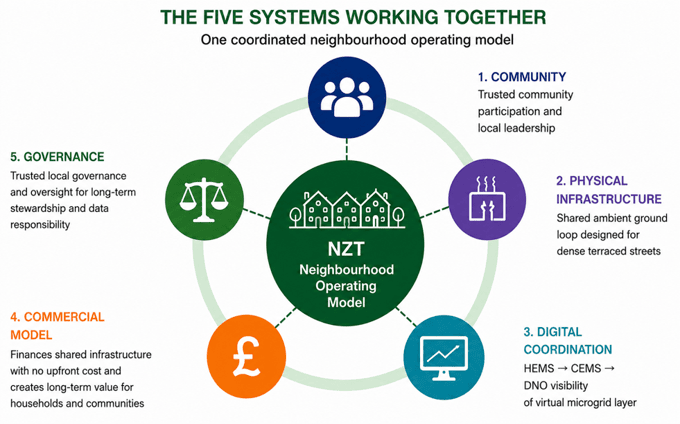
The project will deliver five integrated systems.
- Trusted community participation.
- Shared physical infrastructure designed for dense terraced streets.
- Digital coordination through Home and Community Energy Management Systems, providing feeder-level visibility and neighbourhood coordination.
- A commercial model that finances shared infrastructure and removes the need for upfront household investment.
- Trusted governance that provides long-term stewardship of infrastructure, data and value.
Participation is the critical infrastructure for Net Zero Terrace (NZT) and people will only take part if the offer actually works for them. This is why NZT starts with what mixed tenure households actually need: no upfront cost, affordable energy and healthier, warmer homes. So, everyone benefits from the energy transition, and no one is left behind. It creates energy communities with trust and collective local management integrated into its approach.
Working with our project partners, Northern Powergrid, Buro Happold, UK Power Networks, Centre For Energy Equality, Looped Energy Communities and Greater Manchester Combined Authority (GMCA) the project will start in December 2026 and run until September 2030.